‘ll give you a princess sticker if you practice!” “Pleeeeaaase practice your piano.” “Here’s a chart to track your progress.” And my favorite, “if you practice your piano, I’ll do your dishes.” I never hear of anyone bribing kids to finish their dessert, to play with their friends, or to have story time.
I can’t tell you how many parents have told me “piano lessons were just not fun.” Often they don’t remember anything they learned, and they don’t play anymore.
Traditional methods set most kids up to fail, and practicing can be lonely. Parents end up bribing their kids just to go into another room by themselves and drone through some prescribed lesson material that they really don’t understand. It’s not sustainable, and it’s not fun. The stickers, the prizes, the time and the investment, often ends up teaching kids that they’re just not talented.
Nothing could be further from the truth! All kids are wired for music.
At Little Bird, we have five- and six-year-olds composing music, playing the piano in multiple keys, understanding basic music theory, reading sheet music AND playing tunes by ear. Voluntarily. You might think these are musical prodigies, not average kids who love soccer, playing with their friends, and eating French fries. Actually, they’re normal kids who also started piano classes at Little Bird Piano Academy® when they were tiny. Some as young as 5 months old.
Teaching music to a baby might seem like an overwhelming task, especially since trained professionals will tell you it can’t be done.
I’m always saying “It’s easier than you think, and SO MUCH FUN,” because it is!
If you stopped to think about it, you’d wonder how teaching your baby to speak in two or three languages by the time they’re 3 would be possible, but people do it all the time. No one questions it, because we’ve always done it that way.
Just because music has been traditionally taught beginning at age 6 or 7, doesn’t mean that’s the best way. Research shows that the earlier you start, the more benefits your child will have as they grow. One of my jazz professors in college answered the question as to why it’s so hard to change traditions in colleges and universities, making one hand into scissors and holding an imaginary piece of tape in the other, “because in academia, we like to cut red tape – lengthwise.”
Someone I have a lot of respect for was known to say, “‘Because we’ve always done it that way’ is the worst reason I can think of.” I’ll add, unless it works. But then, “because we’ve always done it that way” isn’t the reason. “Because it works” is the reason. Such as in teaching babies how to talk. When it comes to teaching kids music though, just because we’ve always waited until they could sit still, pay attention, and have a formal music lesson, doesn’t mean that’s the best way.
If you waited until your baby was 6 or 7 and could sit still and have a talking lesson, they might never talk. You’ll have missed the optimal window for language acquisition. Parents teach their babies to talk by talking, listening to the little babbling sounds their babies make as they try to mimic them, and making those sounds back to reinforce and validate what their baby is “saying.” It seems to be very slow progress. In reality, taking 3 to 5 years to learn even one new language is fast, especially given the fact that they started from zero.
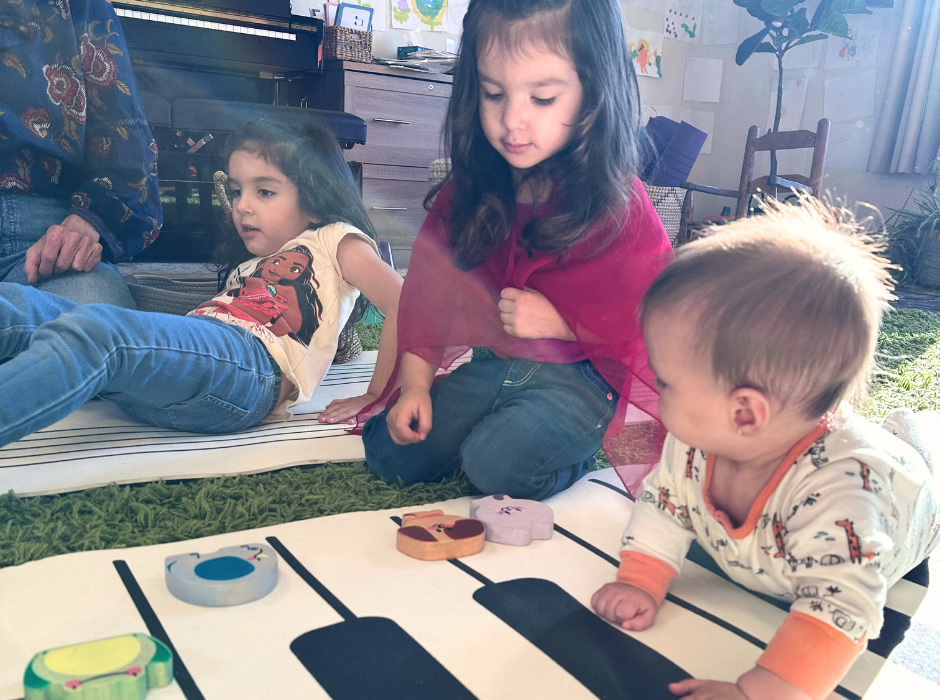
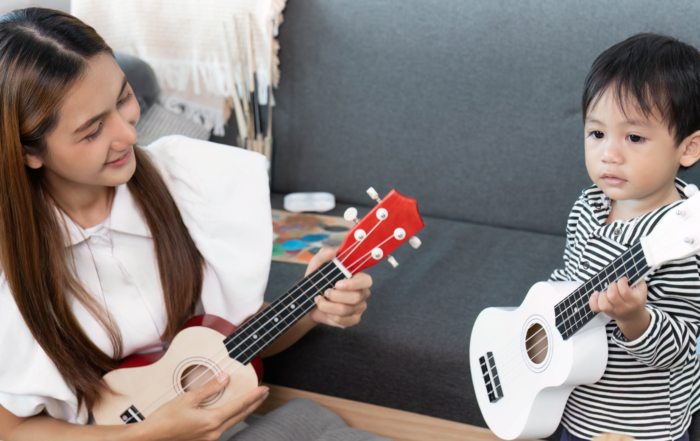
Music is a language, and you can teach it to your baby in very much the same way you teach them to talk- by playing the piano in front of them, singing songs and playing musical games that are tailored just for littles. You validate their musical growth by listening to and mimicking the little things they sing, and the little things they play on the piano with their tiny fists. In my experience, it’s the kids who start the youngest that love playing the very most.
Research shows that prioritizing music training over language training is actually more effective than the other way around. Kids in a study in Spain were given music training, language training, or art training. After two months, the kids who were given music training were found to have more improvement in their language skills than the kids who had art training, or even language training!
The problem is, since academia hasn’t come along yet, most piano teachers don’t know where to begin teaching music to babies, and parents are also at a loss. When I was looking for resources, I couldn’t find much, and nothing for kids under 3. So I made my own. Over the past 30 years or so, I’ve created lots of little songs, games, activities and learning materials; and have tested them out on lots and lots of happy kids and parents. Music class is fun and kids often don’t want to leave. Sometimes their parents have to bribe them with “we’ll go get a treat” or “we’ll go to the park”. The kids finally put their shoes on, we sing The Goodbye Song, and they’re off on their next adventure until next week.
It’s much more fun when the bribing is to get them to stop.


Leave A Comment